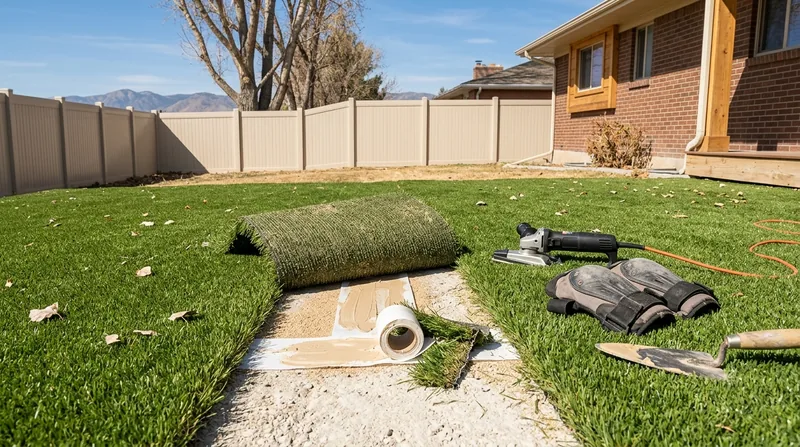




Artificial turf in Idaho Falls faces real wear: freeze-thaw cycles split seams, heavy snow and ice crack edges, and the intense sun-to-shade swings across the Snake River Plain accelerate infill migration and pile matting. Turf repair and seam repair in Idaho Falls keeps an installed yard functional and safe, whether the damage is a separated seam along a patio edge, a lifted corner from frost heave, a flattened traffic lane, or a melt spot from reflected window heat. We have repaired turf across the older Numbered Streets neighborhoods near downtown, the 1950s ranch subdivisions built around the national laboratory, and the newer two-story homes in Ammon and Iona where vinyl fences and foundation plantings create high-traffic zones. Seam separation is the most common call in spring, when thaw and drainage shifts loosen the adhesive; edge lifting happens where frost pressure meets a shallow base or poor compaction; and localized wear appears under dog runs, swing sets, and the paths between a back door and a gate. We handle the repair on site, in writing, with the turf product name, face weight, pile height, and infill type documented so the patch matches the field.
Why Seam and Edge Repair Matters in Idaho Falls: Freeze-Thaw and the Snake River Plain
Idaho Falls sits at 4,700 feet on the upper Snake River Plain, where the winter freeze-thaw cycle and spring runoff create conditions that stress artificial turf seams and edges like few other climates. The silty volcanic soil under most yards drains poorly, so standing water and ice lenses form under the base, lifting edges and pushing seams apart. Snow load in December through March, followed by rapid melt, saturates the base and destabilizes the turf perimeter. A seam that looks fine in July may separate by April when frost pressure peaks. Early repair prevents water infiltration, stops the damage from spreading, and keeps the yard safe for foot traffic and pets.
- We inspect the seam, base, and drainage to identify whether the failure is adhesive breakdown, frost heave, or poor original compaction.
- We remove the damaged section cleanly, exposing at least 12 inches of good turf on either side of the break.
- We prepare the base (re-compact if needed, address standing water or ice), and we re-seam using turf-grade adhesive rated for Idaho's temperature swings.
- We blend the new seam with the existing pile direction, face weight, and infill so the repair disappears into the field.
- We test the seam under foot traffic and document the work in writing with turf specifications.
Caught early, a seam repair costs far less than replacing an entire section, and it restores the safety and appearance of the yard in one day.
Key info: In Idaho Falls and Ammon, spring seam separation is predictable. We recommend a post-thaw inspection in late March or early April each year. If you see a gap wider than a quarter-inch or water pooling along an edge, call us before the damage spreads into the base.
How We Repair Turf and Seams in Idaho Falls: Step-by-Step Process
Turf repair is not a patch-and-go job. We arrive on site, document the damage with photos, test the adhesive bond and base integrity, and plan the repair so the new section matches the old in every visible and functional way. We work in dry conditions whenever possible, because wet adhesive and rain-soaked bases produce weak seams. Our crew brings the turf product that matches your yard by face weight, pile height, and infill type, along with turf-grade adhesive, base materials, and compaction equipment.
- We mark the damage zone and remove the damaged turf section with a clean straight cut on both sides.
- We inspect and repair the base: we remove standing water, re-compact soft spots, and replace compacted base material if frost heave or settling has created a void.
- We position the new turf section, align the pile direction with the field, and apply turf-grade adhesive to the seam.
- We press the seam firmly and let the adhesive cure per manufacturer specs (usually 24 hours before foot traffic).
- We backfill any base gaps, rake the infill to match the surrounding field, and walk the seam under full weight to confirm the bond.
- We photograph the finished repair and leave you a written spec sheet with the turf product, adhesive, and date.
A typical residential seam repair in Rigby or Shelley takes 2 to 4 hours depending on the seam length and base condition. We call ahead and confirm a dry forecast before we start.
Example: A homeowner in Idaho Falls noticed a 6-foot seam separation along the east edge of a residential yard where water pooled after spring melt. We removed the damaged section, re-compacted the soft base underneath, and re-seamed the turf with a new adhesive bond. The repair took 3 hours and cost $480. The yard has held solid for two seasons since.
Turf Repair Methods and Techniques
| Repair Type | Description | Best For |
|---|---|---|
| Seam Re-adhesion | We lift the separated turf edges, clean the old adhesive, apply new turf-grade adhesive, and press the seam back together under weight. | Seam separation caused by adhesive failure or minor frost heave, no base damage. |
| Section Replacement | We remove the damaged turf section with a clean cut, inspect and repair the base, and install a new turf patch matched to the original product spec. | Large seam breaks, melt spots, or localized wear where the base is compromised. |
| Edge Reinforcement | We re-secure lifted edges with adhesive and base material, and we may add a perimeter stake or edging to prevent future frost heave. | Edges lifted by frost, poor original compaction, or drainage issues at the perimeter. |
| Base Repair and Drainage | We excavate soft or settled base, remove standing water or ice lenses, re-grade for drainage, and re-compact with crushed stone to original depth. | Seams or edges failing due to poor drainage, frost heave, or settling; prevents repeat failure. |
| Infill Redistribution | We rake and redistribute infill across worn or matted areas to restore pile height and drainage, and we top-dress with fresh infill if needed. | Flattened traffic lanes, matted pile, or infill migration without structural damage to turf or base. |
The right repair method depends on the root cause. A seam that separated due to poor adhesive alone is a quick re-adhesion; a seam that failed because the base settled under it requires base repair first, or the seam will fail again. We assess on site and recommend the fix that will hold.
Turf Repair and Seam Repair Cost in Idaho Falls: What to Expect
Repair costs depend on the type of damage, the length and depth of the seam, the condition of the base, and whether we need to match the original turf product or source new material. A simple seam re-adhesion on a short break costs less than a full section replacement with base repair. We measure and quote on site, and we never charge for the estimate. Most homeowners in Idaho Falls and Ammon see repair costs between $350 and $1,200 for residential jobs.
- Seam re-adhesion (under 8 feet, no base damage) typically starts at $350 to $500.
- Section replacement (8 to 20 feet, with base inspection) usually runs $600 to $1,000.
- Edge reinforcement and drainage correction (frost heave or settling) ranges $400 to $800 depending on the perimeter length and base work needed.
- Large or complex repairs (multiple seams, significant base failure, or drainage redesign) are quoted after an on-site visit.
Factors that affect the final cost include the turf product name and face weight (we match your existing yard), the length of the seam, the depth of the base repair, and whether we need to address drainage or frost heave. We always provide a written estimate with the repair method, materials, and timeline before we start work. See our full pricing page for more details on how we calculate repair costs across different job sizes.
Turf Repair and Seam Repair Near Me: What Idaho Falls Homeowners Should Know Before Hiring
Not all turf repair crews work the same way. Some apply new adhesive over old, skip the base inspection, or use a mismatched turf product and hope the customer does not notice. We believe the repair should be as well-built as the original installation. Before you call any turf installer, check three things: a current certificate of insurance naming general liability and workers compensation, a written spec of the turf product (product name, face weight, pile height, infill type and pounds per square foot, base depth), and references or photos of finished work in Idaho Falls or nearby towns like Rigby, Shelley, or Ucon. Ask whether the crew will inspect the base and address the root cause of the failure, not just patch the surface. Many seam failures come back because the base was never fixed.
- Request a free, no-obligation estimate and confirm that the crew will document the repair in writing with turf specs and photos.
- Ask about the warranty on the seam: we stand behind our work with a one-year workmanship warranty on the adhesive bond and base repair.
- Check whether the crew has experience with Idaho Falls freeze-thaw conditions and whether they understand the drainage challenges of silty volcanic soil.
- Confirm that the turf product matches your yard by face weight and pile height, and ask how they will blend the infill so the repair is invisible.
- Get at least two estimates before you decide, so you can compare method, materials, and price.
We are fully insured and we have been repairing turf in Idaho Falls and the surrounding areas since 2013. Call us at (208) 932-1139 or visit our contact page to request a free estimate. We respond within 24 hours and we will walk you through the repair process in plain language.
When to Repair vs. When to Replace Your Artificial Turf
A repair makes sense when the damage is localized (one seam, a small section, or an edge) and the rest of the yard is sound. If your turf is more than 10 years old, has multiple seam failures, widespread matting, or deep infill loss across the whole yard, replacement may be a better investment. We can advise on site: sometimes a repair buys you another 3 to 5 years; sometimes the turf has simply reached the end of its life. If you are considering a full replacement, we can also handle the turf removal and install new artificial turf in the same project, so you do not have to hire two crews.
Preventive Care: How to Protect Your Turf from Future Damage
Most seam and edge failures in Idaho Falls are preventable with basic care. Clear debris from the seams after heavy snow or wind. In spring, inspect the perimeter and seams for lifted edges or water pooling, and call us early if you spot a problem. Avoid parking or storing heavy items on the turf, and rake the infill periodically to keep it evenly distributed and prevent matting. If you have a dog run or a high-traffic path, consider regular turf cleaning and infill refresh to extend the life of the yard. A small investment in maintenance now prevents costly repairs later.
Turf Repair & Seam Repair in Idaho Falls: Pricing Guide
| Service | Price | Details |
|---|---|---|
| Seam Re-adhesion | Starting at $350 | Simple adhesive failure on short seams under 8 feet, no base damage, one to two hour job |
| Section Replacement | Starting at $600 | Damaged turf section removed and replaced with matched product, base inspection included, 8 to 20 feet |
| Edge Reinforcement and Drainage Repair | Starting at $400 | Frost heave or settling addressed, base re-compacted, perimeter secured, prevents repeat failure |
| Complex or Large-Scale Repair | On estimate | Multiple seams, significant base failure, or drainage redesign require on-site inspection before pricing |
| Travel and Estimate | Included and Free | No mileage fee in Idaho Falls and surrounding towns, free written estimate within 24 hours |
Indicative pricing, the exact cost depends on square footage, finish, and site access. Free personalized estimate within 24h at (208) 932-1139.


